
RRN Flood Response: Rapid Field Assessment Report
4 September 2026
Dhading, Nuwakot and Rasuwa Districts — Rasuwa–Bhotekoshi Flood, August 2026
Date of Assessments: 30–31 August 2026
Prepared by: Rural Reconstruction Nepal (RRN)
Prepared for: Potential Donors and Partners
Executive Summary
Following the catastrophic Rasuwa–Bhotekoshi flooding of late August 2026, Rural Reconstruction Nepal (RRN) deployed assessment teams to Rasuwa, Nuwakot and Dhading districts- the most affected districts.
Drawing on these field visits and consultations with district authorities, municipal governments, UN and INGO partners, and affected communities, this report consolidates RRN’s on-the-ground findings across all three of the most severely affected districts. The floods have displaced thousands of individuals and families and destroyed critical infrastructure including hospitals, schools, roads and bridges; in Rasuwa specifically, hundreds have died and more than 4,000 people remain missing, with search-and-rescue operations still underway.
This report summarises the situation in each district, the most pressing gaps identified during RRN’s field visits, and RRN’s proposed approach to relief and early recovery support in the coming days.
RRN’s Field Presence
| District | Locations Visited | Date | RRN / Assessment Team | Access |
| Rasuwa | Toward Dhunche via the Betrawati–Pung Khola alternate road | 30–31 Aug 2026 | Dr. Netra Prasad Timsina, Er. Nirajan Pokharel, Dr. Suresh Tamang, Mr. Bharat Sharma, Mr. Hitesh Jimee. | Direct field visit and information gathered via municipal authorities, locally elected representatives, District Coordination Committee (DCC), District Disaster Management Committee (DDMC), locals and secondary reporting. |
| Nuwakot | Bidur Municipality and surrounding wards | 30–31 Aug 2026 | Dr. Netra Prasad Timsina, Er. Nirajan Pokharel, Dr. Suresh Tamang, Mr. Bharat Sharma, Mr. Hitesh Jimee. | Direct field visit; consultations with DCC, DDMC, Civil Society Networks, Nepal Red Cross Society, Municipal Police, Holding Centres and affected people. |
| Dhading | Galchhi Rural Municipality | 30 Aug 2026 | Ms. Madina Paudel, Mr. Kishor Sharma | Direct field visit and interaction with the local government and the affected people, holding centres. |
District Situation:
Rasuwa
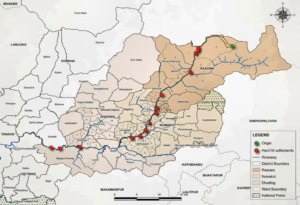
Map 1 – The path of the flood and most affected settlements, from NDRRMA situation report #10 (Nepali) published at 7pm, 31 August 2026.
- Home to an estimated 48,000 people; the epicentre of the Bhotekoshi–Trishuli flooding.
- Hundreds reported dead; more than 4,000 people remain missing, including residents, tourists, pilgrims, hydropower workers, security personnel and journalists.
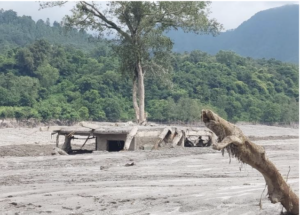
- Villages, tourist sites, trade routes, roads, bridges and hydropower infrastructure have been destroyed.
- Search-and-rescue remains active, involving roughly 20 helicopters alongside security personnel and international volunteers.
- Road access from Nuwakot toward Rasuwa remains largely impassable, making access one of the most severe constraints on the overall response.
Field observations while traveling in Rasuwa – Access remains one of the most critical constraints to the humanitarian response.
Many communities, particularly in the northern areas of Rasuwa, remain inaccessible. There is currently limited information coming from some of these communities. A significant concentration of government agencies, donors, humanitarian organisations, and national and international media was observed in accessible areas, while more remote communities may be receiving considerably less attention.
Key logistical challenges include:
- Major road damage
- Damaged or destroyed bridges
- Complete isolation of some communities – e.g. Ghattekhola
- Limited alternative routes
- Increased transportation costs
- Longer delivery times
- Difficulty transporting bulky relief materials
- Limited opportunities for temporary storage of relief supplies
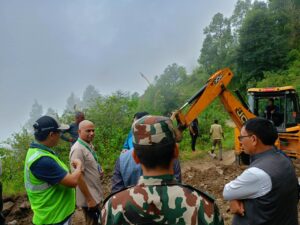
The team travelled toward Pung Khola, near Betrawati, using an alternative route recommended by the Government. The road was in poor condition with constant heavy rains. Large trucks cannot traverse these paths, and we used an SUV (Toyota Prado). Any materials we can provide in the next few days will have to be taken by such SUVs (Toyota Prado, Mahindra Bolero, Mahindra Scorpio etc.). Furthermore, the alternative route requires urgent repair, maintenance, and upgrading if it is to accommodate the anticipated movement of humanitarian relief vehicles.
Helicopters may provide an alternative means of reaching isolated communities; however, this is expensive and over 20 helicopters are currently heavily engaged in search-and-rescue operations. Therefore, alternative road access should be restored and improved as soon as possible.
Uttargaya Rural Municipality, Rasuwa.
Out of 2188 households, 1670 households of Uttargaya-wards 1,2,3,4 and 5 are affected by this flash flooding. Among them 1,100 households are displaced, 1,100 houses completely destroyed, and 570 houses are partially damaged, 500 people are reported missing from this rural municipality. There is immediate requirement of Shelter items, Non-food items, food items and Hygiene kits.
Gosaikunda Rural Municipality, Rasuwa.
Altogether 5 wards out of total 6 wards are severely affected; ward no. 2 & 5 are completely damaged. Rural Municipality office, 2 ward offices, 1 community building, 2 RCC bridges and 2 schools have fully damaged. Altogether 500 people are reported missing and 900 people are displaced and have been rescued and transferred to Yellow Gumba in Swoyambu Kathmandu. There is no road access and no electricity is available after this crisis. There is immediate requirement of food items, solar lamps and cooking gas.
Nuwakot — Bidur Municipality
- 10 of 13 wards significantly affected; Wards 1, 3, 7, 9 and 10 among the worst-hit.
- Approximately 1,600 people displaced across roughly 10 holding centres; about 1,300 households require transitional shelter.
Dhading — Galchhi Rural Municipality
- Three wards (4, 6 and 8) affected; Ward No. 6 identified as the worst-hit.
- Approximately 200 families displaced; more than 80 private businesses affected.
- The 15-bed Baireni Hospital significantly damaged — X-ray machine, laboratory equipment and generator destroyed.
- Three schools and eleven suspension bridges damaged.
- No human casualties reported within the municipality.
- Around 15 organisations are coordinating relief through the municipality’s one-door distribution policy.
- More than 19 bridges lost or damaged; the municipal water supply system is also damaged.
- Severe overcrowding reported at some centres — e.g., approximately 1,000 people across four rooms at one school-based centre.
- The NGO Federation estimates the district’s total affected population could reach 30,000–40,000, though this figure is unverified.
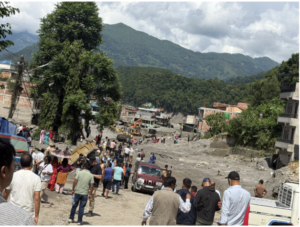
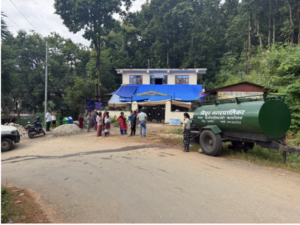
Humanitarian Partners Already Engaged
RRN’s field visits confirmed that other humanitarian actors are also assessing the situation in the districts, underscoring the need for RRN’s assistance to be closely coordinated rather than duplicative.
Rasuwa
- In Rasuwa, the District Disaster Management Committee (DDMC) is leading relief efforts, as the most severely affected wards (Wards 1, 2, 3 and 4 of Gosaikunda Rural Municipality) remain completely inaccessible by road. Very few agencies currently have a presence on the ground in these areas, and air lifting remains the only viable option for transporting relief materials there.
- Our team remains in constant contact with our partners in Rasuwa district and is coordinating with local authorities on initial relief and recovery planning. With road access into the district still largely cut off, we are sustaining this coordination channel and drawing on relationships already established in Rasuwa, positioning us to act quickly and effectively once a fuller field presence becomes possible (see Section D, Extending Access to Rasuwa, below).
Nuwakot
- Nepal Red Cross Society and the NGO Federation of Nepal (district chapter) — relief coordination and distribution.
- Save the Children and Plan International — protection and child-safeguarding support in holding centres.
- Armed Police Force — doctors and nurses providing basic medical services at holding centres.
- Despite this support, significant additional relief and recovery assistance is still needed across the district.
Dhading
- OXFAM/Focus Nepal have provided — food and non-food items for 100 affected families.
- World Food Programme (WFP) — food assistance for 270 families for an initial 15 days, with planned follow-on cash assistance.
- Buddhist Tzu Chi Foundation (Taiwan) and DanChurchAid (DCA) Nepal — emergency relief operations underway.
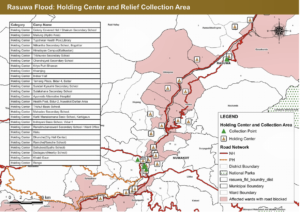
Map 2 – Holding centres and relief collection areas, from NDRRMA situation report #01 (English) accurate as of 6pm, 1 September 2026.
Gaps Identified During RRN’s Field Assessment
- Needs-verification gap — relief materials are being collected and distributed in several locations without being matched to verified household-level needs, risking duplication in accessible areas and shortages in harder-to-reach ones.
- Access and information gap — Rasuwa and other remote, northern communities remain largely unreached by road; helicopter capacity is fully committed to search-and-rescue.
- Shelter and WASH gap — thousands of households need transitional shelter; drinking-water systems are damaged in all three districts, and several holding centres remain overcrowded with inadequate sanitation and privacy.
- Health system gap — Baireni Hospital and other health posts are damaged or non-functional, with destroyed equipment and disrupted essential services.
- Protection and psychosocial gap — families who have lost multiple relatives, unaccompanied or orphaned children, and displaced women and older people need dedicated protection and psychosocial support, particularly in Nuwakot and Rasuwa.
- Education disruption — multiple schools are damaged across all three districts, with no transitional learning arrangements yet in place.
- Approaching winter — winterisation needs (warm clothing, blankets, winterisation kits) are not yet integrated into the emergency response.
Proposed Way Forward — How RRN Can Proceed
- Immediate, Needs-Verified Relief (next 1–2 weeks)
- Support rapid, ward- and household-level needs verification with local governments and Ward Chairpersons to close the current data gap.
- Channel relief through existing one-door coordination mechanisms (district/rural municipality warehouses) to avoid duplication.
- Prioritise shelter materials, drinking water, NFIs (blankets, clothing, hygiene kits) and kitchen utensils in the worst-hit wards of Dhading and Nuwakot.
- Health and WASH Support
- Support restoration of essential services at damaged hospitals and health posts across the three districts.
- Contribute to emergency water supply, storage and treatment for holding centres and damaged municipal systems.
- Protection, Psychosocial Support and Education
- Support psychosocial counselling and protection services for bereaved and displaced families, particularly women, children, older people and persons with disabilities.
- Support family tracing and information services for people still searching for missing relatives.
- Contribute to transitional learning spaces so that children’s education is not indefinitely disrupted.
- Extending Access to Rasuwa
- Continue efforts to reach Rasuwa as road access allows, prioritising this district given the scale of loss and the current information gap.
- Coordinate with DDMC/DCC and NDRRMA to identify safe access windows and support road-repair advocacy where feasible.
- Winterisation and Early Recovery Planning
- Integrate winterisation items into ongoing distributions rather than treating this as a later-phase activity.
- Begin early planning for recovery of damaged roads, bridges, water systems, schools and health facilities alongside emergency response.
Call to Partners and Next Steps
Building on these findings, RRN is scaling up its field presence. On 4 September, one RRN team travelled to Nuwakot to distribute relief materials directly to affected households and holding centres, while a second team departed for Rasuwa on a combined five- to six-day mission covering both relief distribution and further on-the-ground evaluation of the district’s hardest-hit wards.
RRN is seeking support from donors and partners to help close the gaps identified above and extend this response to the hardest-to-reach communities, particularly in Rasuwa.
For partnership inquiries, please contact:
Dr. Netra Timsina, RRN Executive Director, [email protected]
Dr. Suresh Tamang, RRN Director of Research and Strategic Partnerships, [email protected]
Ms. Reshma Shakya, RRN Programme Coordinator, [email protected]