
Following the catastrophic flooding that struck Nepal’s Rasuwa, Nuwakot and Dhading districts in late August 2026, Rural Reconstruction Nepal (RRN) deployed rapid assessment teams to all three districts between 30–31 August to gauge the scale of damage and identify the most urgent needs.
Rasuwa: the Epicentre
Rasuwa, home to an estimated 48,000 people, bore the brunt of the disaster. Hundreds have died and more than 4,000 people remain missing, among them residents, tourists, pilgrims, hydropower workers and security personnel. In Uttargaya Rural Municipality, 1,670 of 2,188 households have been affected, with 1,100 people displaced and 500 still missing. In Gosaikunda Rural Municipality, five of six wards are severely affected, with government offices, schools and bridges destroyed, 500 people missing and 900 displaced people evacuated to Kathmandu.
Road access into Rasuwa remains one of the biggest obstacles to relief. RRN’s team travelled into the district itself, via an alternative route recommended by the government along roads leading toward Dhunche, where deteriorating roads and continuous rain made travel difficult . With more than 20 helicopters already committed to search-and-rescue, road repair remains an urgent enabling need. RRN is maintaining close coordination with partner organisations already active in upper Rasuwa, positioning the organisation to scale up quickly once access improves.
Dhading and Nuwakot: Damage and Displacement
In Dhading’s Galchhi Rural Municipality, roughly 200 families have been displaced and over 80 businesses affected, with the district’s main hospital significantly damaged. In Nuwakot’s Bidur Municipality, 10 of 13 wards are significantly affected, with around 1,600 people sheltering across ten holding centres, some severely overcrowded.
Common Gaps
Across all three districts, RRN’s assessment identified consistent gaps: relief is not yet matched to verified household-level needs; shelter, clean water and sanitation remain insufficient; health facilities are damaged; and families lack adequate protection, psychosocial support, and continuity of education. With winter approaching, warm clothing and bedding are not yet part of the response.
Building on these findings, RRN is scaling up its field presence. On 4 September, one RRN team will travel to Nuwakot to distribute relief materials directly to affected households and holding centres, while a second team departed for Rasuwa on a combined five- to six-day mission covering both relief distribution and further on-the-ground evaluation of the district’s hardest-hit wards.
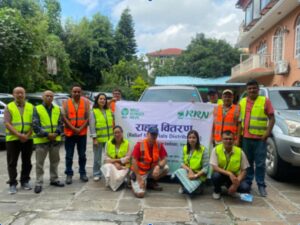
RRN continues to coordinate closely with district authorities, CSO networks, and fellow humanitarian partners to ensure aid reaches those most in need without duplication. Organisations and individuals wishing to support this response can reach RRN by contacting one of the following personnel:
- Dr Netra Timsina, RRN executive director, [email protected]
- Dr. Suresh Tamang, RRN director of research and strategic partnerships, [email protected]
- Ms. Reshma Shakya, RRN program coordinator, [email protected]