
RRN Joins Regional Call for Climate Justice and Loss and Damage Finance Following Rasuwa-Bhotekoshi Floods
Rural Reconstruction Nepal has been engaging with regional and international partners over the past week in a series of webinars addressing loss and damage finance in the wake of the August 26 Rasuwa-Bhotekoshi flood disaster. The events bring together civil society organisations, parliamentarians and affected community representatives to push the conversation from immediate relief toward accountability and climate reparations.
On September 9, RRN collaborated with ActionAid Association India on the webinar “Himalayan Floods August 2026: Solidarity, Recovery and Resilience.” Scheduled to run from 3:30 to 4:30 pm IST, the session extended to nearly two hours as discussion continued well past its planned close. Panelists included Dr. Arjun Karki, Member of Parliament and a former President of RRN, Dr. Bimala Rai Paudyal (former Foreign Minister of Nepal), and Dr. Prem Dangal, Member of the National Assembly, alongside Saroj Pokhrel of ActionAid Nepal. The session was moderated by
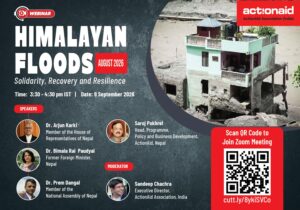
Sandeep Chachra, Executive Director of ActionAid Association India. RRN Executive Director Dr. Netra Timsina attended and spoke, restating the organisation’s views on recovery and reparations, thanking ActionAid and fellow participants for their continued solidarity, and providing an updated picture of conditions on the ground in the flood-affected districts.
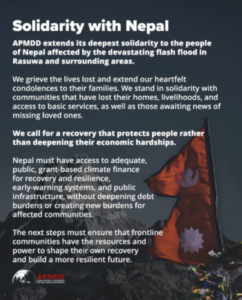
RRN also collaborated on September 4 with the Asian Peoples’ Movement on Debt and Development (APMDD) for the webinar “Nepal Flash Floods: Call for Solidarity and Reparations.” The session framed the disaster as a matter of climate justice, arguing that Nepal, despite contributing minimally to global emissions, should not be left to rebuild through debt while high
emitting nations escape accountability. The program opened with remarks from APMDD Coordinator Lidy Nacpil, followed by testimony on the human cost of the floods from Pema Wangmo Lama of Women from Indigenous Nationalities (WE-WIN) and Smritee Lama of the General Federation of Nepalese Trade Unions (GEFONT). Dr. Karki addressed Nepal’s response and the politics of recovery, before the floor opened to questions from participants and closing remarks from Nacpil. Dr. Timsina attended and spoke at this session as well, reiterating RRN’s position on non-debt-creating climate finance, thanking partner organisations for their solidarity, and sharing updates from the field response in Rasuwa.
Dr. Karki’s participation across both webinars carries particular weight for RRN given his history with the organisation as a former President, linking the network’s institutional voice directly to Nepal’s national policy conversation on disaster recovery and reparations. Dr. Timsina’s presence at both sessions reinforced that connection, positioning RRN’s field-level experience directly within the regional advocacy conversation.
Dr. Karki, along with Dr. Bimala Rai Paudyal and the RRN team, is travelling to Rasuwa tomorrow as part of RRN’s ongoing response and field engagement. The visit will let the team assess conditions on the ground and get a clearer sense of what affected communities need most, while also identifying where RRN can extend further support. Findings and updates from the visit will be shared with relevant stakeholders in the days following.
These engagements form part of RRN’s broader participation as a collaborator and network partner in regional advocacy on loss and damage finance, alongside organisations including ActionAid, APMDD, GEFONT and WE-WIN. RRN continues to contribute field-level perspective from its ongoing response work in Rasuwa, Nuwakot and Dhading to these wider conversations on non debt-creating climate finance and reparations for climate-vulnerable communities.