
RASUWA-BHOTEKOSHI FLOOD
Situation Report — Rural Reconstruction Nepal (RRN)
| 13 SEP 2026
DATE |
19:00 NPT
AS OF |
EVOLVING
STATUS |
| PRELIMINARY NOTE
Headline figures below are drawn from NDRRMA’s प्रतिकार्य स्थिति प्रतिवेदन #२३ (“Response Status Report #23,” Nepali-language, 19:00 NPT, 13 September 2026), cross-checked against NDRRMA’s English-language Situation Report #11 (19:00 NPT, 12 September 2026) for day-on-day change. Figures translated from the Nepali source by RRN; all remain provisional and subject to NDRRMA reconciliation. |
1 HIGHLIGHTS
- New government cash relief scheme announced. Following a Cabinet decision of 2083/05/25 (~10 September), NDRRMA has begun implementing monthly cash relief for families in 15 local levels across Rasuwa, Nuwakot, Dhading, Tanahun and Gorkha whose homes were fully destroyed: NPR 15,000/month for families of up to 4 members, plus NPR 2,000/month per additional member, for up to 6 months or until alternative housing is arranged. This applies only to families opting out of holding centres to arrange their own temporary housing; families who decline can instead receive government-arranged temporary housing. This is a distinct, more specific mechanism than the NPR 160 million lump-sum cash relief reported earlier in the response and does not appear to have been captured in yesterday’s English SitRep.
- Holding-centre population has dropped sharply. 33 centres, 2,532 people (Rasuwa 825/9 centres, Nuwakot 1,613/22 centres, Dhading 94/2 centres), down from 36–37 centres and 3,434–3,761 people the day before. The timing lines up with the new cash-relief scheme, though the report doesn’t state a cause.
- Deaths edged up, missing held flat for a third straight day. Bodies recovered rose to 1,388 (+2), while total missing stayed at 5,130 for a third consecutive report.
- Two hydropower search sites have dropped off today’s SAR table: the Rasuwa Bhotekoshi Hydroelectric Project (where a body was recovered yesterday) and Mailung Khola no longer appear, suggesting those operations may have concluded.
- A new landslide has blocked the Trishuli 3A tunnel mouth, caused by continuous rainfall; clearing work is underway.
- New river monitoring: for the first time since the flood, the Hydrology and Water Resources Research Centre (CHWRR) has installed a CCTV camera about 70m above the river at Timure, feeding live footage into CHWRR’s 24-hour flood forecasting service.
- Total rescued has also held flat at 13,728 for a second straight day, alongside missing figures, suggesting the operation has firmly shifted from live rescue to recovery.
2 SITUATION OVERVIEW
Search, rescue, body recovery and relief operations continue along the Rasuwa-Bhotekoshi corridor. Today’s reporting shows a mix of operational wind-down at some hydropower search sites, a new weather-related setback at another, and the rollout of a significant new cash-relief mechanism aimed at moving displaced families out of holding centres. (Note: today’s NDRRMA excerpts do not restate the original hazard-cause figures — e.g., the initiating avalanche’s scale or Devighat peak discharge — carried in earlier reporting; RRN can retain those from prior sitreps if wanted.)
3 LATEST VERIFIED NATIONAL FIGURES
| Indicator | 12 Sep, 19:00 | 13 Sep, 19:00 |
|---|---|---|
| Bodies recovered | 1,386 | 1,388 (+2) |
| Missing | 5,130 | 5,130 (unchanged, 3rd static report) |
| Total rescued | 13,728 | 13,728 (unchanged) |
| Treated / discharged | 339 / 269 | 339 / 271 (+2 discharged; 32 referred, 4 deaths, 32 under treatment) |
| Helicopter flights (Nepal Army), cumulative | 1,482 (+27) | 1,516 (+34 today) |
| APF flights, affected areas | 320 | 320 (unchanged, 3rd static report) |
| DNA samples: remains / relatives | 1,286 / 1,779 | 1,286 / 1,846 (+67 relatives; remains flat) |
| Deceased breakdown: female / male / partial remains | 334 / 542 / 510 | 334 / 542 / 512 |
| Holding centres / people | 36–37 (conflicting) / 3,434–3,761 | 33 / 2,532 (internally consistent) |
| Fuel: diesel / petrol / air fuel (litres) | 44,000 / 17,000 / 9,000 | 33,000 / 18,000 / 15,000 |
| Gas cylinders sent to Rasuwa, cumulative | 75 (today’s addition) | 502 (cumulative to date) |
| Telecom sites operational | not stated | 193/198 (Nepal Telecom 117/120, Ncell 76/78) |
4 SEARCH AND RESCUE AT HYDROPOWER SITES
- Rasuwagadhi (120MW): Nepal-5/Australian DART-4 team searched and returned. New today: the report flags a genuine operational constraint, difficulty transporting heavy equipment to the site due to terrain, needed to sustain the search.
- Langtang (20MW): Clearing of the blocked entrance continues; nothing found inside the tunnel; a 3-member DART drone team observed the site and has since withdrawn to Trishuli.
- Chilime (22MW): Debris cleared roughly 70m inside the tunnel; blasting/track work for heavy-equipment access restated as complete. Personnel figures remain unreconciled and have now shifted a third time across three consecutive reports: 37 Nepal Army/20 Indian Army in one bullet and 30/34 in another on 11–12 September, and 15 Nepal Army/12 Indian (incl. NDRF) in today’s report. This is now a persistent, worsening discrepancy worth flagging to NDRRMA directly rather than treating any single figure as authoritative.
- Upper Trishuli-1 (Audit-3): Water still flowing from the tunnel, entry risk remains elevated. Today’s report gives a single, consistent figure (1 Nepal Army + 9 Australian personnel) with no second conflicting number, resolving the discrepancy carried in the two prior reports.
- Trishuli 3A (60MW): New setback: continuous rainfall triggered a landslide that has blocked the tunnel mouth; clearing work is underway to reopen it. This wasn’t present in yesterday’s “no items found, SAR ongoing” framing.
- Trishuli 3B (37MW): Reframed today in elevation terms: excavation has reached 651m depth against a river surface at 653m, but the building structure still hasn’t been located. This appears to walk back yesterday’s report, which described reaching the B1/B2 building base via recovered beams and brick fragments. Worth flagging as an unresolved inconsistency between the two days’ reports rather than treating either as settled.
- Not in today’s table: Rasuwa Bhotekoshi Hydroelectric Project (site of yesterday’s body recovery) and Mailung Khola. Their absence suggests these operations may have concluded, though this isn’t stated explicitly.
- Nepal Army and Indian Army are working jointly on a tunnel breakthrough at Chilime to open the route further.
5 ACCESS, INFRASTRUCTURE AND ALTERNATIVE ROUTES
- Krishnabhir (Prithvi Highway): Still fully obstructed; ~250m of track opened, gravelling now underway. Three alternative routes to Kathmandu via Abukhaireni remain available (via Salyantar–Dhadingbeshi–Mastar, a Sunaulabazar variant, or via Benighat).
- Tribhuvan Highway: One-way past the Nagdhunga/Pataleban landslides; Nagdhunga Tunnel traffic restored.
- Galchhi–Devighat–Trishuli: Debris cleared near Thuli Khola; Ratamate back-cutting continues with 2 added machines; Kolphu Bridge one-lane traffic restored.
- Bidur–Betrawati: 9.2 of 10km clear; gravelling has started on the remaining stretch. New: foundation excavation has begun for a Bailey Bridge at Betrawati.
- Devighat Acrow bridge: Operational; remaining launching-nose components and accessories are being stored at Army Training Centre No. 1.
6 GOVERNMENT RESPONSE AND COORDINATION
- New cash relief scheme (see Highlights) is the major development, targeting families with fully destroyed homes across 15 local levels in 5 districts.
- Additional budget has been released for search-and-rescue equipment procurement: NPR 90 million to Nepal Army, NPR 60 million to Nepal Police, NPR 60 million to Armed Police Force Nepal.
- Preliminary damage/loss assessment is described as complete, with the detailed Post-Disaster Needs Assessment (PDNA) process still ongoing. This is a notably more cautious framing than yesterday’s report, which presented specific RDNA figures (NPR 40,828.91 crore in damage, NPR 72,331.52 crore in recovery needs) without the “preliminary/still in progress” qualifier. RRN should treat yesterday’s monetary figures as provisional pending the fuller PDNA, per today’s own report.
- Three shelter-cluster partner meetings have produced a draft “Resettlement and Shelter Management Action Plan, 2083” and a detailed damage-assessment work plan; DUDBC has completed discussion of 1-room, 2-room and 3/4-room prototype transitional shelter designs.
- A virtual review meeting was held between the central command post and the Rasuwa, Nuwakot and Dhading district command posts on search, relief distribution and temporary housing arrangements.
7 COMMUNICATIONS AND ENERGY
- Telecom: Nepal Telecom 117/120 BTS towers operational; Ncell 76/78. Combined 193/198.
- Satellite: 6 of 29 satellite internet terminals operational in Nuwakot, 4 in Rasuwa.
- Service gaps: Chilime Khola, Trishuli 3B and Uttargaya-1 (Tiru) remain without service due to power outages.
- Fuel and gas: see figures table above; diesel stock fell sharply (‑11,000L) while air fuel rose (+6,000L), suggesting active resupply prioritising air operations.
8 NOTABLE CHANGES AND INFORMATION GAPS
- Holding-centre figures are now internally consistent (33 centres, 2,532 people) after conflicting counts on 11–12 September, a genuine improvement in data quality.
- The Chilime personnel discrepancy has now produced a third distinct figure in three days and should be raised with NDRRMA directly rather than resolved by RRN’s own judgment.
- The Trishuli 3B building-location claim from 12 September appears to be walked back today; treat yesterday’s “base reached” framing as unconfirmed.
- RDNA monetary figures circulated on 12 September should be treated as preliminary, per today’s own PDNA-in-progress language.
- DNA sample collection from remains has plateaued at 1,286 across three consecutive reports even as the confirmed body count continues to inch upward, a possible reporting lag worth watching.
9 RRN FIELD RESPONSE
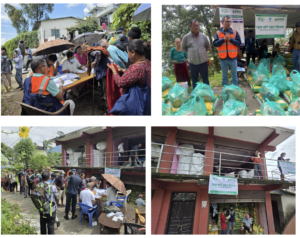
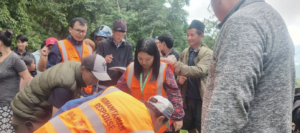
RRN’s Rasuwa operation, supported by Welthungerhilfe (WHH) and Aasaman Nepal, worked three fronts over this period: continued distribution by the team stationed in the district since 9 September, a six-truck relief convoy that reached the district’s most cut-off wards after an overnight journey, and a fresh push into Gosaikunda.
Kalika — Ramche (11 September)
Food distribution began at 11:30am in Ramche, Ward 1 of Kalika Rural Municipality, reaching 166 flood-affected households. Ward Chairperson Mr. Dawa Lama was present. The distribution followed directly from an assessment RRN’s field team had carried out in Ramche the day before, when they met Kalika RM Chairperson Mr. Hari Krishna Devkota and other municipal officials to discuss the situation of affected and displaced families and the needs of households with missing members.
Uttargaya — the Danda Gaun convoy (11–13 September)
RRN dispatched six trucks from Kathmandu on the morning of 11 September, bound for Danda Gaun in Rasuwa to serve Wards 1, 2 and 3 of Uttargaya Rural Municipality, wards that municipal leadership had confirmed two days earlier as still unreached by any relief distribution. Three trucks carried food; the other three carried non-food relief including winter clothing and blankets, the first winterisation materials RRN has brought into the Rasuwa response. The convoy took the long southern route via Galchi in Dhading, a detour made necessary by damage along the direct approach to northern Rasuwa. Two RRN frontline staff, Mr. Duryodhan Adhikari and Mr. Raj Chauhan, travelled with the trucks and overnighted at Deurali.
The convoy reached Rasuwa on 12 September after travelling overnight through hazardous, muddy mountain paths and completed its first delivery at Danda Gaun, Ward 1, offloading relief materials for a ward that had remained difficult to reach since the floods struck.
On 13 September, Duryodhan and Raj facilitated distribution of food and non-food relief to 345 affected families across Ward 1 and Ward 2 (Danda Gaun) of Uttargaya. The disaster has severely disrupted life in this area, sweeping away homes, farmland and infrastructure across Paira Besi, Kharetar and the neighbouring hydropower corridors. With the main transport route cut off, freight costs have risen as much as 50 times normal, leaving families short of everyday staples like salt, cooking oil and food grains. Alongside relief distribution, field teams are working to address students’ need for educational supplies as communities begin to rebuild.
Gosaikunda — Bhimale and Sole (12 September)
RRN’s team in Dhunche distributed relief food to flood-affected families in Bhimale and Sole, Gosaikunda Rural Municipality–6, reaching 70 households. The package followed the government-standard flood-response composition (rice, lentils, sugar, salt, cooking oil, chiura) plus Sarvottam Pitho, a fortified flour supplement for emergency nutrition support. Ward 6 is among the areas hit hardest by the floods, with 53 people still reported missing; the community depends heavily on agriculture and livestock, both of which have taken a heavy toll, with farmland swept away and many households losing livestock central to their income and food security. The distribution was coordinated with Ward 6 Chairperson Mr. Dawa Sirdar Waiba and other local representatives.
Where things stand
Relief is now reaching wards that had gone unserved through the response’s first two weeks, Uttargaya’s Wards 1–3 and Gosaikunda-6 among them, but the same access constraints that delayed that reach (washed-out roads, a long detour through Dhading, freight costs up sharply) continue to limit how much can move and how fast. Winterisation materials have entered distribution for the first time this round; student educational supplies are emerging as a next-priority gap alongside food and NFI needs.
Coordination and contacts
Project Focal Person, Rasuwa Response: Er. Nirajan Pokharel, [email protected]
Field Coordinator, Rasuwa: Mr. Lil Bahadur Karki, [email protected]