
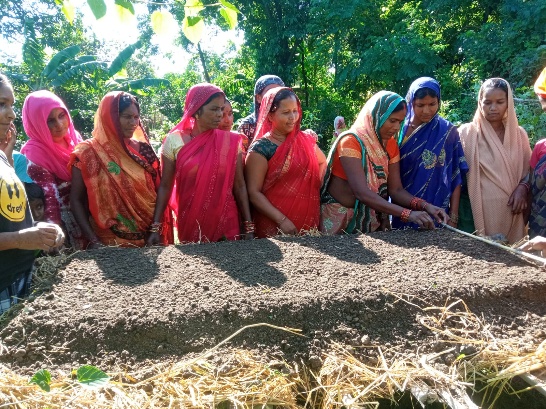
The project “Empowered Citizens Promoting Food and Nutrition Governance in Three Municipalities of Kapilvastu District”, funded by BMZ/WHH and implemented by RRN/KIDS, has supported farmers in five wards of Kapilvastu Municipality for the past 1.5 years. A key focus of the project is the promotion of Good Agricultural Practices (GAP) to strengthen safe, healthy, and climate-resilient production. As part of the GAP curriculum, farmers were introduced to improved nursery management techniques, including the Tadhe Nursery, an elevated seedbed designed to prevent waterlogging and flooding during the rainy season.
Initially, most farmers relied on traditional raised or flat beds and were hesitant to adopt the Tadhe method, considering it difficult to construct. Early adopters such as Rajmati Murau of the Shanti Kalika Farmer Group and Ramawati Kewat of the Janaki Farmer Group were exceptions. When heavy rains persisted for three days, nurseries in wards 2, 3, 4, and 11 were destroyed, seedlings were washed away, survival rates dropped, and vegetable production was severely affected. In contrast, the Tadhe nurseries set up by Rajmati and Ramawati remained intact. Their protected seedlings allowed timely transplantation, resulting in good vegetable yields and increased income.
Seeing this clear advantage, farmers quickly shifted their practice. In the following rainy season, around 12 Tadhe nurseries were established independently by farmers, demonstrating strong adoption and confidence in the technique. Farmers also reported reduced issues of damping‑off and disease incidence. As farmer Kabuttar Ahir from the Tauleshwor Nath Farmer Group expressed, “This technique is very useful. Previously, flooding was a major problem for nursery raising and vegetable production in the rainy season. Now, with the Tadhe Nursery, we can avoid this issue.”
The Tadhe nursery has emerged as a simple yet effective climate‑resilient solution, enabling farmers to protect seedlings, ensure timely planting, secure vegetable production, and ultimately strengthen both livelihoods and household nutrition during periods of heavy rainfall.